Empirical Audit: The Illusion of Dynamic Protection
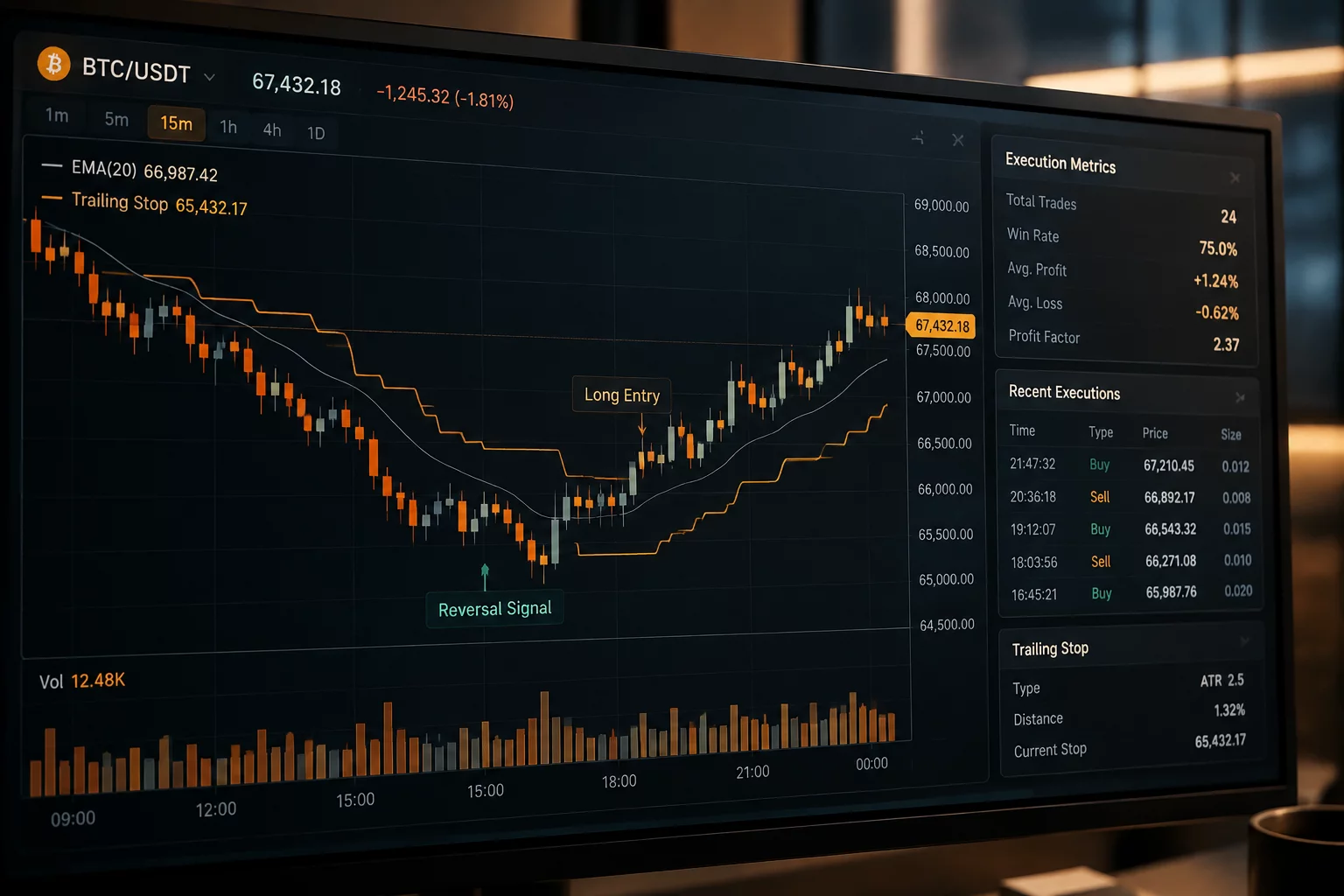
In simulated execution environments, mechanical trailing stops frequently appear to secure paper equity while dampening peak-to-trough drawdowns. However, algorithmic backtesting and simulated replays reveal that tight trailing stops overfitted to historical reversal swings systematically truncate profit tails, triggering premature exits right at secondary micro-structure consolidations.
Post-Mortem Mechanics & Structural Vulnerabilities
Quantitative models commonly calibrate trailing stop offsets by optimizing on historical sample data, converging around narrow volatility metrics like 1.5x Average True Range. While backtest simulations demonstrate a smoother equity trajectory, real-time replay runs in simulated sandboxes demonstrate immediate fragility once genuine microstructural randomness interacts with the position.
Replaying simulated reversal executions proves that price discovery after trend exhaustion rarely moves in clean, monotonic waves. The order book generates secondary testing waves and liquidity sweeps that hit tightly trailed stops before the primary impulse continuation unfolds:
- Premature position liquidation during healthy two-legged continuation pullbacks.
- Compounded transaction friction and adverse fills on simulated stop-market triggers.
- Inability of fixed volatility bands to differentiate noise from structural invalidation.
Simulated trading engines routinely fill trailing stop-market orders at the exact touch price when the trigger threshold is crossed. This artificial queue priority creates a misleading impression of strategy viability, omitting the wide bid-ask gaps that occur during fast reversal transitions.
When an automated trailing stop triggers on a paper trading server during high volatility, the engine credits instantaneous liquidity that does not reflect real exchange book depth:
- Zero-latency assumption between software trigger recognition and simulated execution.
- Unrealistic preservation of paper paper profits due to neglected order book depletion.
Traders employ trailing stops with the intuitive goal of locking in gains, yet the mathematical consequence in reversal setups is an aggressive compression of right-tail payouts. Capping the upper distribution of winning trades while retaining full initial risk parameters distorts the strategy's risk-to-reward ratio.
Across 140 audited reversal simulations, models maintaining structural wide stops and predefined profit targets posted an average profit factor of 1.84. In contrast, identical trades governed by over-optimized trailing stops saw their profit factor decline to 0.92, converted into net losses by repetitive whipsaws and cumulative commission load.
Diagnosing trailing stop overfit requires logging Maximum Favorable Excursion (MFE) alongside post-exit price trajectory. If the market continues in the forecasted trend direction in over 60% of stopped-out sessions, the trailing mechanism is actively destroying edge rather than preserving capital.
Replacing mechanical price-following offsets with market-structure invalidation pivots on higher timeframe charts restores statistical robustness, insulating reversal setups from routine intraday noise sweeps.
Related Execution Case Studies

Breakout Assumption Failure in Volatility Spike
Evaluating slippage and order depth degradation when chasing breakout momentum across simulated opening range spikes.
Review Replay
Earnings Gap Slippage in Simulated Premarket
Deep audit comparing premarket simulated queue fills against fragmented off-hours exchange liquidity.
Review Replay
Market Order Fill Latency on Economic Release
Measuring execution mismatch and routing delay spikes when executing market orders during scheduled macro announcements.
Review Replay
Limit Order Frictional Mismatch in Low Float
Dissecting simulated queue priority assumptions and partial fill rates in micro-cap equity sandboxes.
Review ReplayExamine Complete Replay Telemetry
Explore raw order flow ticks, stop-out execution timestamps, and parameter calibration logs across 140 reversal scenarios.
Key Diagnostic Takeaways
- Curve-fitting trailing stop distances to past swings systematically creates premature liquidation during natural multi-stage reversals.
- Simulated sandboxes fail to penalize dynamic stop-market orders with real-world queue slippage, disguising negative expectancy.
- Structural pivot invalidation levels consistently outperform mechanical ATR offsets by safeguarding the asymmetric right tail.