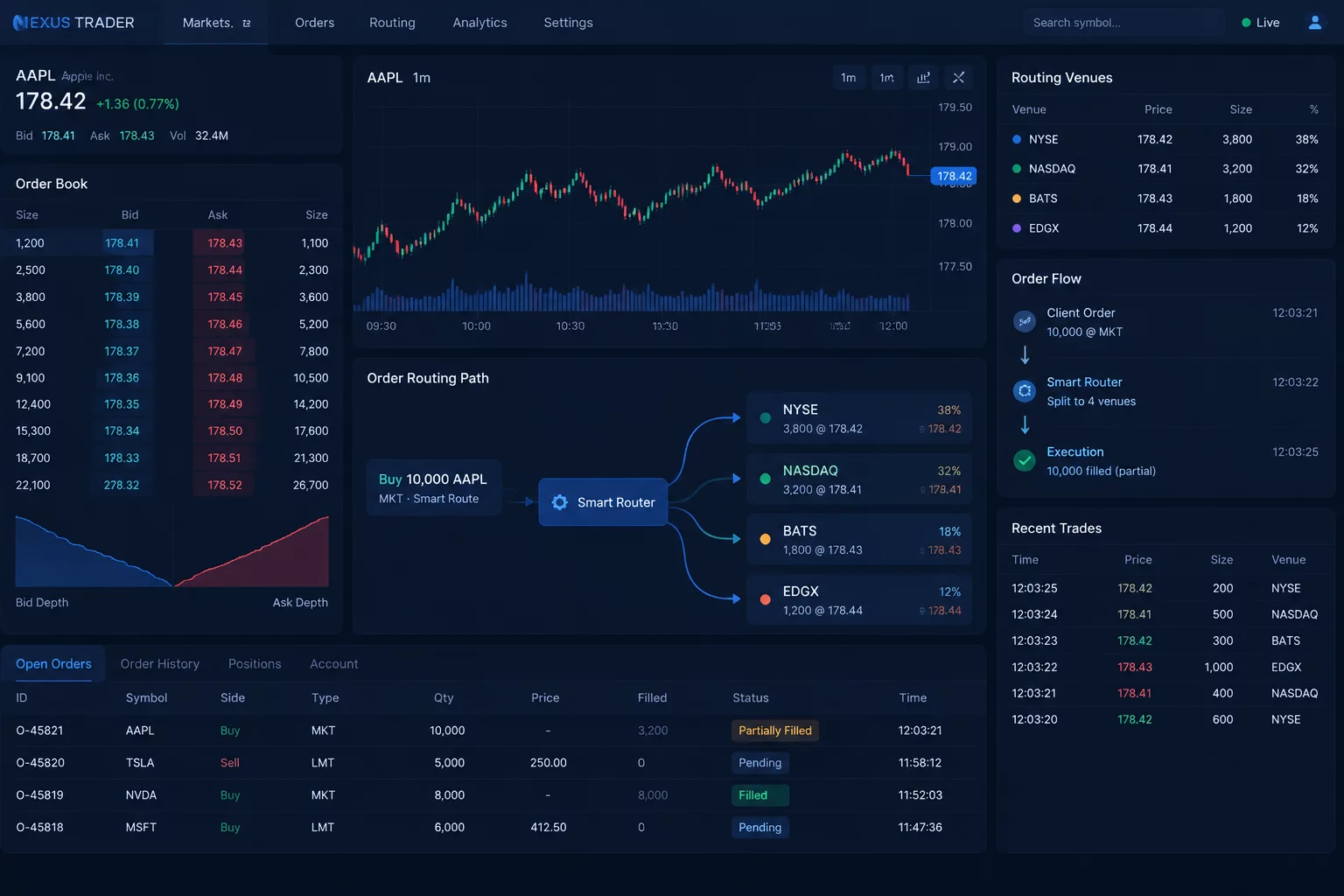
Replay diagnostics comparing paper queue fills against real-world order book liquidity
Dismantling fictitious execution quality, zero-slippage myths, and simulated queue priority before scaling trade capital.
Simulated paper trading accounts consistently reward flawed execution timing by omitting real-world mechanics like depth exhaustion, bid-ask queue waiting times, and adverse selection.
When a trader enters an order inside a demo account, the matching engine usually evaluates the print against last traded price. A single round-lot trade touching your limit order often triggers a total fill for thousands of shares in paper software. In production market conditions, your order sits at the end of the matching queue. Thousands of shares ahead of you must be satisfied first. The difference between an immediate simulated fill and a canceled partial order in live markets creates an accidental edge that vanishes the moment real capital enters the book.
| Execution Dimension | Simulated Baseline | Audit Diagnostic |
|---|---|---|
| Limit Queue Fill Logic | Fills instantly on single price touch | High Distortion |
| Market Spread Slippage | NBBO mid-quote assumed with 0c slip | Moderate Gap |
| Order Book Depth Impact | Unlimited size absorption at top price | Critical Risk |
| Quote Delivery Latency | Pristine localized data stream (0ms) | Unrealistic |
Paper account balances create a soothing psychological shield. Without economic vulnerability, traders hold drawdown positions through wide excursions that would provoke panic liquidations with real balances. This tolerance allows mean-reverting positions to recover by pure happenstance, disguising terrible trade premises as profitable decisions.
Compounding this psychological factor is the mechanical absence of liquidity exhaustion. When testing illiquid equities or low-float momentum runners, paper engines grant fills at printed prices where real market depth contains barely a few hundred shares. The trader logs a theoretical gain of several points, unaware that executing that volume in live markets would have pushed the ask price ten percent higher before entry completion.
Applying these adjustments routinely strips 40% to 75% of cumulative gains from a standard demo statement. Strategies that survive this stringent filter reveal genuine statistical validity, while accidental edges collapse into immediate net loss realities.
A strategy that requires instant queue priority and zero spread slippage to show positive expectancy does not possess an edge; it possesses an accidental exploit of simulator benevolence.
— David Chen, Senior Execution Analyst
Most sandbox platforms trigger limit orders immediately upon a solitary printed trade at that price level. In live markets, you join the back of the queue at the exchange, requiring all preexisting shares at that bid or ask to clear first before your allocation triggers.
Incorporate fixed execution drag into your journal: deduct between 1 to 3 cents per share on liquid equities, or a full half-spread on options, while discarding fills that occurred on candle wicks without volume support.
Standard sandbox platforms fail to simulate sub-second queue dynamics and cancellation speeds accurately. High-frequency micro-scalping edges developed in demo accounts almost invariably fail during live transitions due to microsecond exchange latency.
Access forensic replay case studies and filter out synthetic alpha from your records.