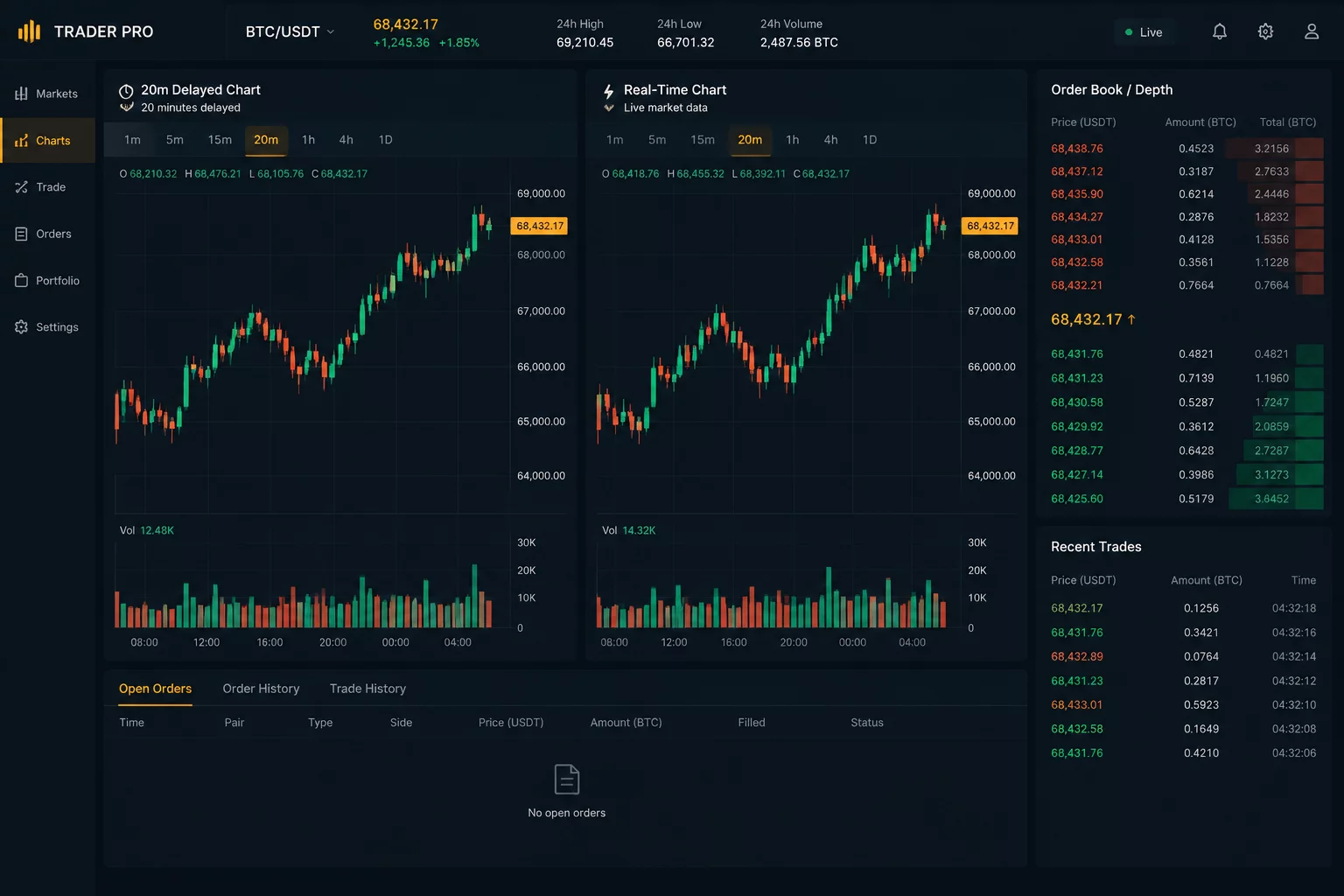
Time-skew audit comparing delayed simulator fill queue stamps against exchange auction timestamps.
Calibrating trade post-mortems and eliminating lookahead distortion when executing against delayed sandbox market feeds.
Standard paper trading accounts operate on a twenty-minute quote delay. Traders frequently forget that simulated order matching engines still benchmark orders against delayed candles rather than live book queues.
This latency produces severe behavioral distortion when an operator cross-references real-time market commentary or live news tickers while placing simulated orders. A setup appearing on a delayed chart reflects price discovery that occurred twenty minutes ago in live market depth. When post-trade analytics fail to adjust for this chronological offset, recorded paper profits represent phantom performance derived from accidental hindsight.
| Audit Parameter | Protocol Standard | Status |
|---|---|---|
| Clock Offset | Exactly 1,200 seconds delayed against live tape | Verified |
| News Correlation | Delayed news stream required to prevent lookahead bias | Isolated |
| Order Matching | Post-mortem NBBO cross-check on delayed prints | Audited |
| Bracket Execution | Adjusted for retrospective spread widening | Calibrated |
Executing orders inside a sandbox with 20-minute latency while viewing real-time quotes on external monitors fundamentally destroys the simulation integrity. Traders often believe they are testing immediate decision-making reflexes, yet their cognitive process incorporates future price path information already known to the wider market.
To extract meaningful skill development from delayed accounts, the practitioner must treat the simulation as a blind retrospective study. Every recorded entry requires documentation of both the platform clock timestamp and the actual market bar time. This dual-clock discipline ensures that when slippage and bracket targets are reviewed, the post-trade analysis accounts for the historical spread that existed at that specific instant.
Applying these structured constraints transforms an imperfect delayed simulator into an effective sandbox. Post-mortem audits then reflect deliberate process execution rather than serendipitous timing anomalies.
Trading against delayed quotes with real-time awareness is not practice—it is subconscious hindsight bias. True execution rigor begins by synchronizing your audit clock with the delayed tape.
— Elena Rostova, Senior Execution Analyst
Swing setups operating on daily or multi-day timeframes experience less friction from delayed feeds than intraday scalping strategies. However, opening and closing price executions still require verification against auction prints.
In high-volatility events, a delayed simulator triggers stop orders according to the delayed print rather than the actual live spread, creating unrealistic safety buffers that disappear in live market conditions.
Enabling real-time non-professional market data agreements is ideal, but when operating with delayed data, strict audit protocols in your Replay Sheet ensure realistic friction logging.
Review diagnostic logs and structured post-mortem sheets to uncover sandbox execution discrepancies.