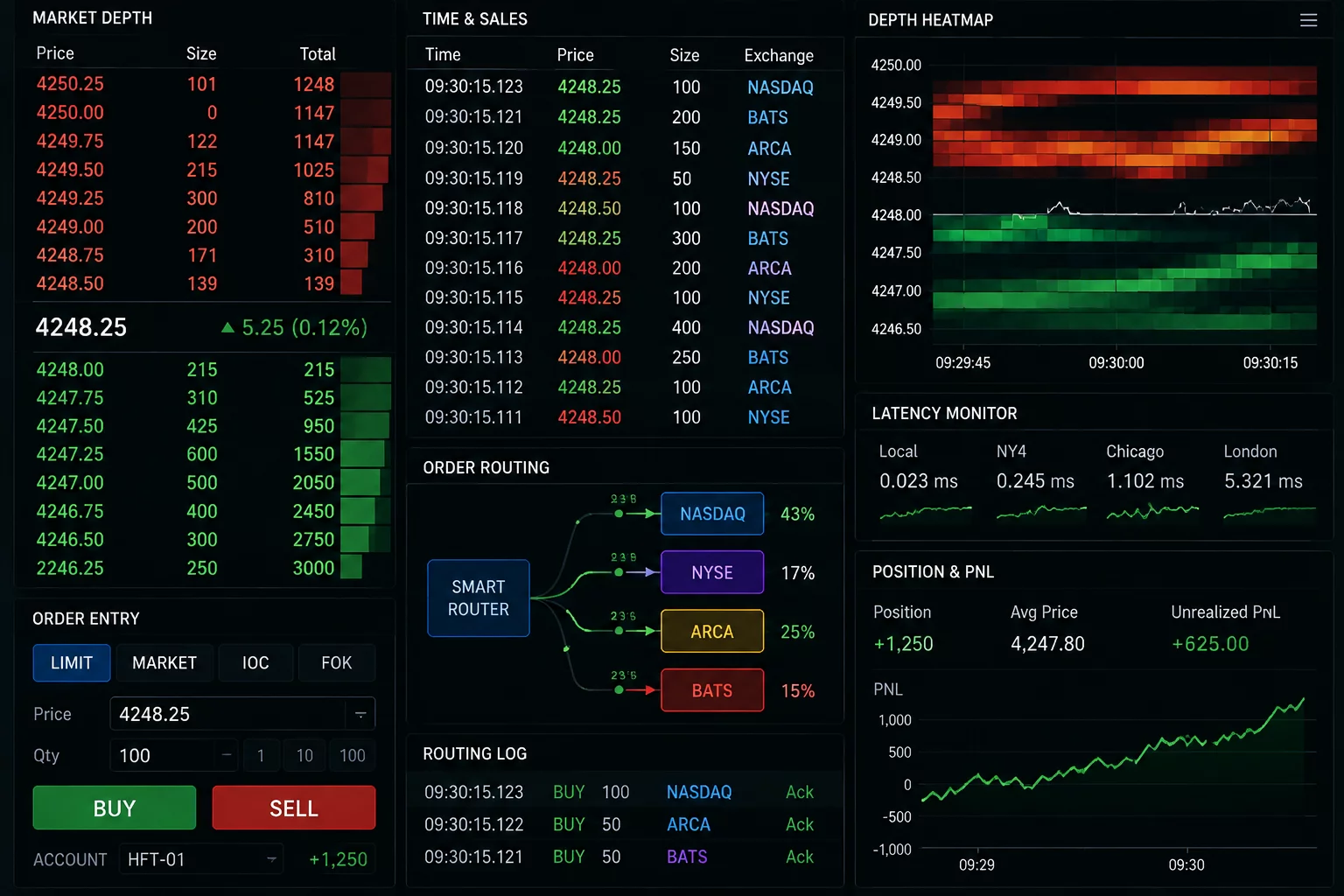
Systematic pre-trade premise matrix comparing catalyst dynamics, queue positioning, and invalidation criteria.
Establishing falsifiable criteria, liquidity conditions, and risk thresholds prior to order routing to eliminate post-fill cognitive bias.
Entering an order without written, falsifiable assumptions transforms simulated practice into an exercise in narrative rationalization.
In simulated execution environments, the absence of real capital consequences often encourages traders to skip formal hypothesis definition. When an order executes based solely on intuition or visual momentum, retrospective analysis becomes nearly impossible because there is no benchmark against which to judge whether the setup succeeded or failed on technical merit. By establishing rigid boundaries for market mechanics, depth availability, and price invalidation before routing the order, the simulation practitioner creates an objective baseline for subsequent post-trade audit.
| Assumption Parameter | Verification Criterion | Audit Requirement |
|---|---|---|
| Catalyst & Regime | Explicit order book imbalance or structural break confirmed on higher timeframe | Mandatory Pre-Log |
| Invalidation Boundary | Fixed tick level where trade thesis is mathematically and structurally void | Non-Negotiable |
| Queue & Fill Expectation | Anticipated fill latency and passive spread slippage model assigned | Systematic Standard |
| Target Horizon | Predetermined time-decay threshold or liquidity target zone | Mandatory Check |
The core hazard in simulated trading is hindsight distortion. When a simulated trade is profitable, traders habitually attribute the success to tactical brilliance, even if the trade drifted through severe adverse excursion before resolving favorably. Conversely, losing trades are often blamed on platform latency or unrealistic simulator fills rather than a defective thesis. Rigorous pre-entry formulation neutralizes this psychological trap by demanding that every order is accompanied by a documented hypothesis.
A complete entry assumption requires three distinct components: a descriptive market condition, a mechanical trigger, and a strict falsification boundary. The descriptive condition defines the state of liquidity and structural momentum across multiple timeframes. The mechanical trigger governs the exact order type and execution protocol utilized to capture the edge. Finally, the falsification boundary establishes the precise price point or environmental change that proves the thesis incorrect.
Incorporating this rigorous workflow transforms sandbox paper trading into professional quantitative preparation. Practitioners who diligently log their assumptions before clicking the order button routinely find that half of their impulsive ideas fail the pre-flight check, saving valuable replay iterations for high-conviction executions.
If you cannot write down the exact condition that proves your trade idea wrong before you transmit the order, you are not trading a system; you are simply gambling with fake chips.
— David Chen, Head of Quantitative Replay Analysis
Once an order is executed, cognitive bias and outcome bias inevitably alter your recollection of why the trade was initiated. Logging pre-entry assumptions locks down your real-time thinking, allowing an unbiased audit between initial expectations and ultimate execution realities.
Intraday formulations do not require lengthy essays; standard shorthand tags covering setup category, precise invalidation tick, and expected volume profile confirmation take less than ten seconds to register when utilizing structured replay templates.
Yes. In algorithmic sandboxes, pre-entry assumptions correspond to the parameter constraints, volatility regimes, and queue estimations coded into the model prior to backtesting or forward paper deployment.
Explore our library of empirical simulation case studies and trade post-mortems across multiple asset classes.